A CFU, or check for understanding, is a formative assessment and a crucial part of instruction. Are students ready to move on to working independently? Are students ready to move on to more rigorous problems? A check for understanding can answer these questions as well as help you identify which students need additional support.
What makes an effective CFU?
A check for understanding has a few components that make it effective:
- It is delivered in real-time. A CFU isn’t something you grade after class.
- It is responsive and immediate. An effective CFU allows you to determine if you need to go over a misunderstanding during instruction.
- A CFU can be delivered during any point of instruction. Multiple CFUs are recommended.
- Ideally, a CFU should be completed independently by all students. However, students can discuss their answers with a fellow student or group after completion.
- Using fingers to show a scale of understanding (5 – I totally get it! 1 – I need help!) can be used for students to assess their own understanding, but it shouldn’t be your ONLY method to check for understanding.
What are some practical ways to include CFUs?
Great news! CFUs don’t require an additional resource or piece of technology. You can simply ask students to work on an existing problem on their own and circulate to see how your students do.
Take this lesson on The Slope Formula from our 8th grade CCSS curriculum:
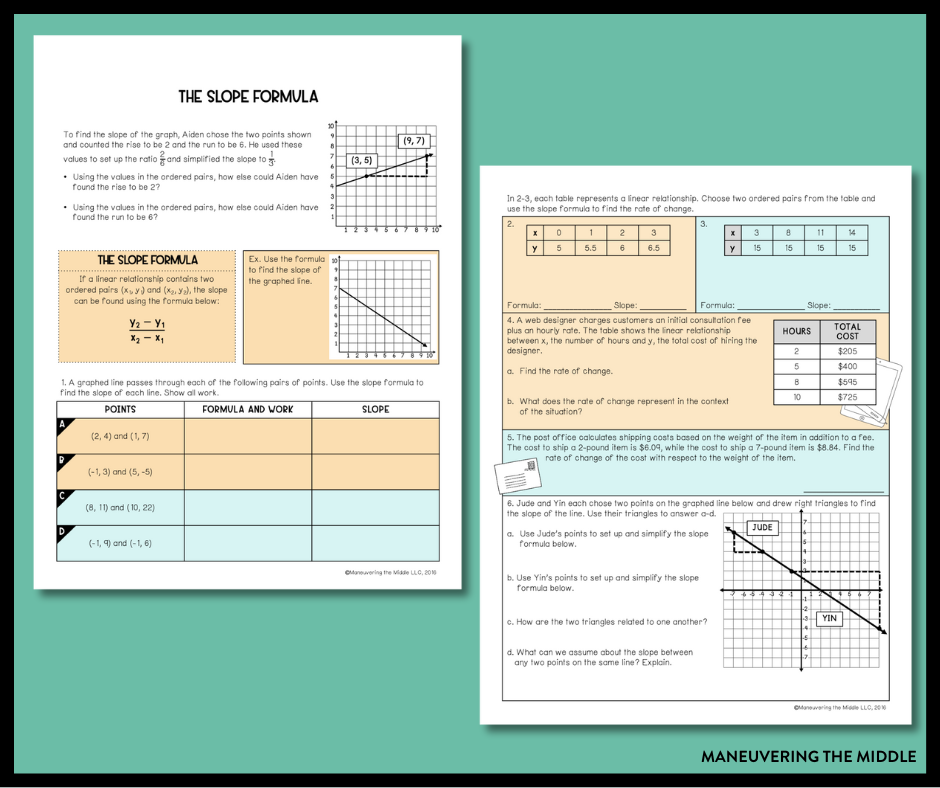
The problems in orange are for instruction – either explicit instruction or instruction with guiding questions. The problems in blue provide an opportunity to check for understanding. Notice that checks for understanding only come after instruction.
Not only does a CFU help determine whether it is time for you to move on, but it also increases student engagement. Students should be working as hard as you, teacher! Students will start to daydream if they are listening to a teacher talk through 10+ math problems.
A CFU doesn’t have to be the final answer to a problem either! For the slope formula, a simple CFU could be for students to identify y2, y1, x2 and x1. In fact, for problems with multiple steps, I actually recommend breaking it down like this.
- First round: Identifying y2, y1…
- Second round: Putting the points in the slope formula by checking the written equation
- Last round: Solving for slope
But how do you check 30 students’ understanding?
This is the most challenging part, but hear me out. When I see teachers circulating when students are completing a CFU, they tend to beeline to help a struggling or off-task student and get stuck there. Circulate first! And then take a beat to check in with students who need more support.
** Helpful hint: Consider your circulatory path when making your seating chart. **
Here are a few of my rules to make CFUs more successful:
- Ask students to box or point to what you are checking.
- Have students utilize hand signals to signal “done.”
- Make sure you know the answer you are looking for, so you can zip by and move quickly to other students.
You can either make a mental note on who needs more help, and when your brain can’t keep track of how many students got it wrong, then it usually means that it isn’t time to move on.
What do you do if it’s not time to move on?
If your students are not ready to move on, it is time to analyze. What type of error are you seeing? Are they making computation errors or procedural errors? Are they struggling to get started?
If they are struggling to start, work out another problem for them or ask a guiding question or two to help get them started.
- Computation errors – address it. “I noticed there were some errors on calculating -1- (-1). Can someone remind me how we subtract a negative?”
- Procedural errors – address it. “I noticed the answers 2/11 and 11/2 when I was walking around. Can you tell me how someone could have gotten 2/11?” (Answer: they set up change of x/change of y instead of change of y/change of x).
- Check out more questioning strategies here.
Whiteboards are your BFF
Student whiteboards are another easy way to gather information from your students. If you are a first year teacher, a class set of clipboard whiteboards is a great investment. Students work out a CFU on their whiteboard and hold it up. This will allow you to quickly scan and gather the necessary data.
Technology Ideas
If you have access to a class set of Chromebooks, then you can also use the following websites to gauge understanding. (I would probably only use these websites for a CFU if I was using them for another part of the lesson.)
- Blooket – This platform is probably my favorite. The problems show on the students’ screen, and accuracy is valued over speed.
- Wayground (previously Quizizz) – This platform now allows you to differentiate questions.
How do you check for understanding?