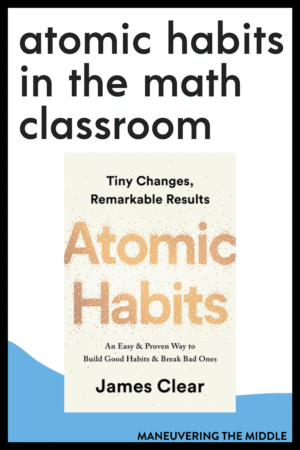
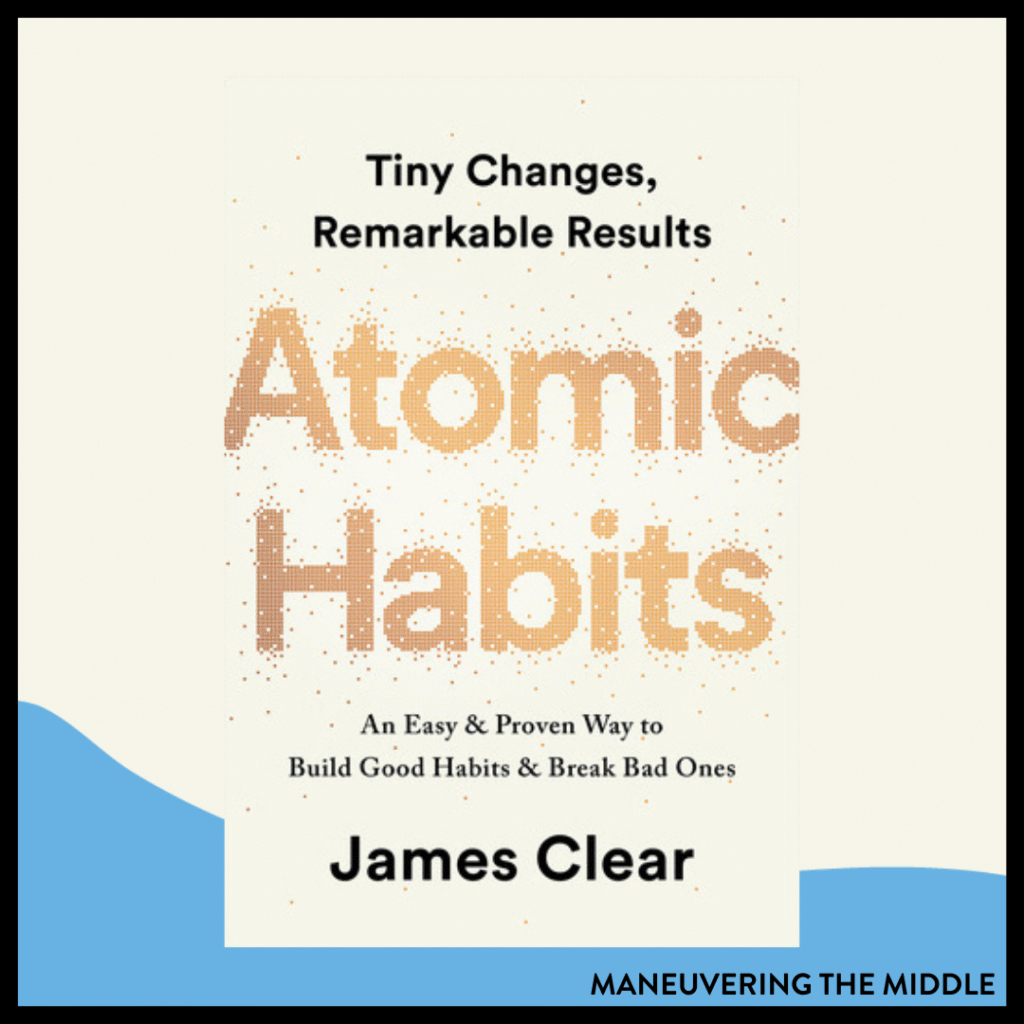
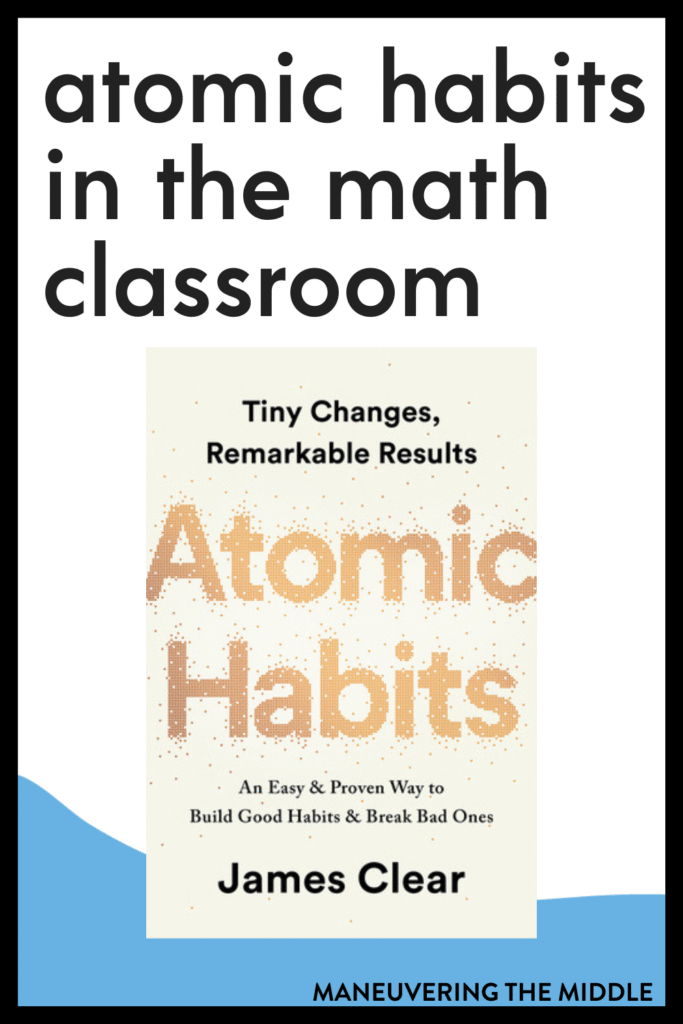
At the beginning of this year, I reread Atomic Habits to jump start all of the better choices I would be making in 2026. If you haven’t read Atomic Habits, the author, James Clear, provides a framework for how to effectively change your habits to get 1% better every day – I highly recommend it!
When I initially read the book, I focused on how I could use this framework to be healthier, more productive, and achieve more of my goals. Upon my reread, I thought about how many of these principles can be applied to students’ mindsets in math. Let’s talk about the 3 principles that I believe students can benefit from.
Note: Atomic Habits is so chock full of highlights that I will be quoting it ad nauseum so bear with me.
The 1% Rule
The gist of the 1% rules states that big transformations are fictional, and that success occurs only when small habits are in practice. A small habit isn’t exactly remarkable, but over time, it can lead to long-term success. Clear states, “Time magnifies the margin between success and failure. It will multiply whatever you feed it. Good habits make time your ally. Bad habits make time your enemy.”
Let’s apply this to the classroom! For the purpose of this blog post, I am going to use multiplication fact fluency as our intended outcome for Atomic Habit application. Please know that you could apply this framework to anything: homework completion, participation, or routines and procedures.
Let’s say for 2026, you help set a student goal that everyone will have their times tables memorized. That’s great, right? But how is that going to be achieved? “You do not rise to the level of your goals. You fall to the level of your systems.” Let’s talk about how to build a trajectory that puts your students in reach of multiplication fact fluency.
Identity Mindset
In order to achieve said goals by developing systems, we need to focus on who we wish to be. For your students, it can be as simple as the mantra, “I am good at math.”
“The most practical way to change who you are is to change what you do. It is a simple two-step process:
- Decide the type of person you want to be.
- Prove it to yourself with small wins.”
What does a good math student do? Do they get started right away or goof off when the teacher isn’t looking? Do they listen and take notes during instruction, or do they zone out and fall asleep? When a student continues to choose to do what someone who is good at math does, they will start being good at math. “The more you repeat a behavior, the more you reinforce the identity associated with that behavior.”
I can visualize a poster that asks “What does a good math student do?” on a wall that a teacher can point to when a student is off task. Subtle and right to the point!
4 Steps to Atomic Habit Creation
Let’s jump into how we are going to create a system for math fact fluency. There are 4 laws of behavior change that will help us build better habits: make it obvious, make it attractive, make it easy, and make it satisfying.
Make it obvious
There are two concepts that will aid in making a new habit obvious: an intention strategy and habit stacking. An intention strategy states: I will [BEHAVIOR] at [TIME] in [LOCATION]. Habit stacking pairs a current habit with a new habit. As a teacher, you have a lot of control in this situation.
The intention strategy could be “I will work through my multiplication flash cards at the beginning of math class.” Then, habit stack. “After I sit down in class (current habit), I will fill out a multiplication chart (new habit).” You could encourage students to do something similar outside of the classroom too.
Even if you aren’t focusing on fact fluency, are your directions exceedingly obvious? Short and sweet and posted for easy access?
Make it attractive
The more attractive the habit, the more likely you are to stick with the habit. You can do this by temptation bundling. “The strategy is to pair an action you want to do with an action you need to do.” “After I go through my multiplication flash cards [HABIT I NEED], I get to put a sticker on the sticker chart [HABIT I WANT].”
Again, outside of our fluency goal, we can apply the make it attractive principle to classwork completion. Is the work assigned interesting and engaging? Is there an opportunity for an activity?
Make it easy
Humans are inclined to choose the path of least resistance. In order to make our math fact fluency habit easy, here are two ideas:
- Remove the friction of students digging through their backpacks to find flashcards and provide a class set at every desk or table.
- Have students grab a set of flashcards as they walk through the classroom door.
Included with that is to add friction to unwanted distractions. For example, phones aren’t allowed out of backpacks or must be turned in at the beginning of class. (See my post about cell phones in schools here.)
Lastly, starting small is another way to make it easy. When building a new habit, it is crucial that it is easy to start and should only last a few minutes. Set a timer for 2 minutes.
Making it easy isn’t saying that math should be easy, but the directions should be. Do students know what to do if they get stuck? Do you have a procedure in place for absent students to get caught up?
“The first three laws of behavior change … increase the odds that a behavior will be performed this time. The fourth law of behavior change – make it satisfying – increases the odds that a behavior will be repeated next time.”
Make it satisfying
Humans prefer instant gratification, so to build a habit, we need to leverage that by adding pleasure after the habit is completed. Perhaps it is a sticker or a piece of candy after the flash cards have been reviewed. Eventually, as the reward of math fact proficiency improves, students will become less concerned with chasing the secondary reward.
Positive narration was my free and simple way of making it satisfying to learn in math. You can read more about creative incentives.
What I covered in this post is only about half of what Atomic Habits covers. There are still chapters on habit tracking, accountability partners, and how to break bad habits. And while you may take this information to your students, I hope it can also be applied to something in your life, teacher. What habits are you hoping to build in your classroom?
WHAT IS MANEUVERING THE MIDDLE?
If you find this information helpful, consider checking out more of our resources! At Maneuvering the Middle, we design and develop standards-based math resources for grades 5 – Algebra 1. Our curriculum provides high quality, engaging resources for students and provides teachers with planning resources and plenty of training.
- All Access: standards-based, on-level curricula available for grades 5 – Algebra 1
- Maneuvering Math: a skill-based intervention program for middle school math students