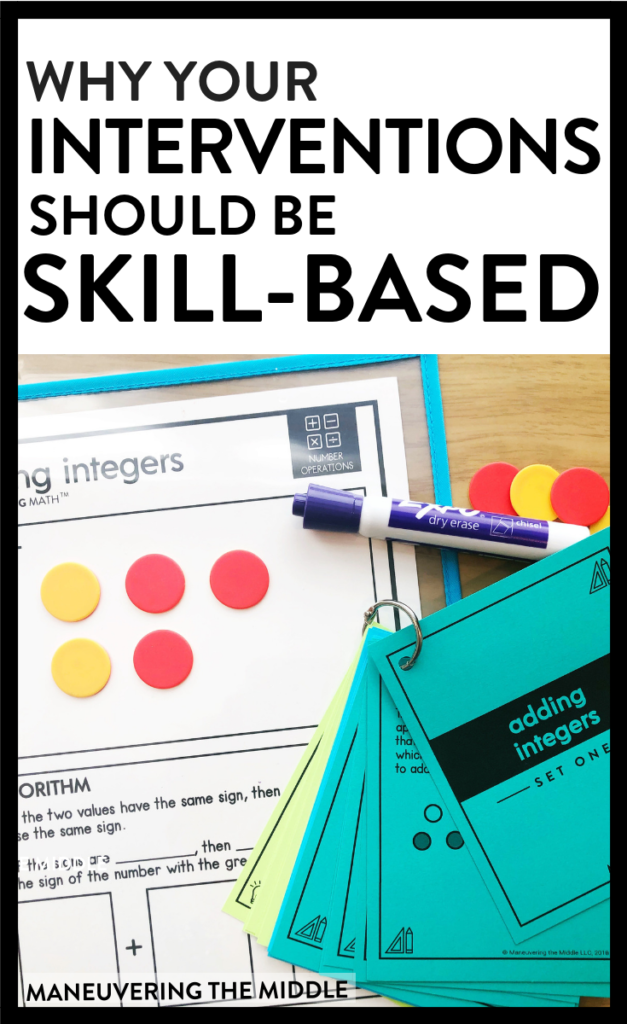
Over the past several months, I have been sharing quite a bit about best practices that surround the concept of math intervention. We have discussed strategies for improving number sense, getting started, and what to do when your students are all on different pages. Today, I want to discuss why I believe that a skill-based math intervention approach is the best one to take.
SKILL-BASED MATH INTERVENTION
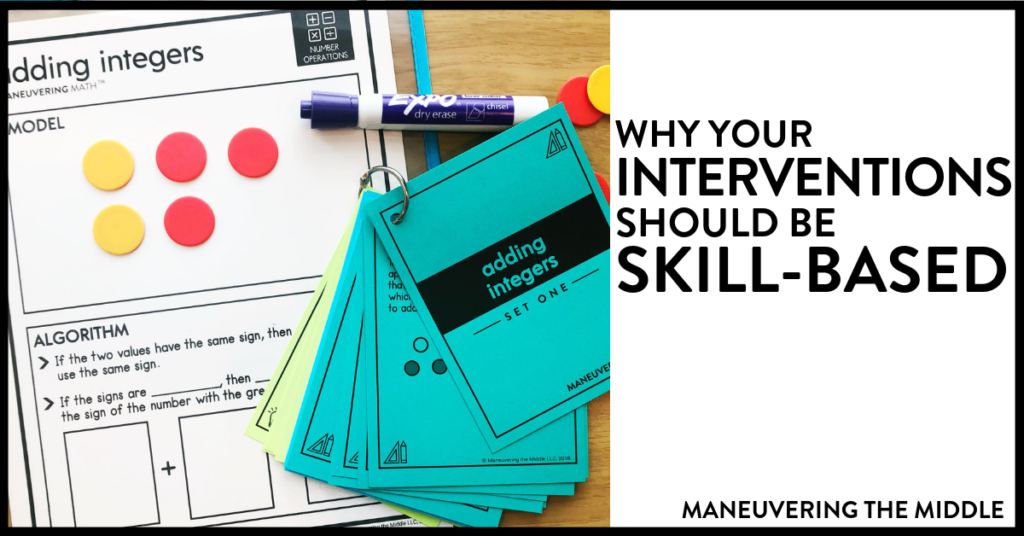
When we set out to write our Maneuvering the Middle math curriculum, the first non-negotiable for us was that everything we wrote would be standards-based. That means that we would use the standards (CCSS and TEKS) as the backbone for our resources. We would develop resources that met the depth and complexity of the standards.
We did this because, as a teacher, it is important. At the end of the year, there is a set of standards that the state says your students must master.
When we began working on Maneuvering Math™, we knew that we couldn’t take the same approach.
What is RTI?
If you are new to teaching or just need a little refresher, RTI (response to intervention) is a formal process in which a team (parents, teachers, campus staff, and the student) works toward finding the level of support needed for a student to succeed.
There are three levels to the RTI process in which all students fall.
- Tier 1: This is high-quality instruction in an on-level classroom; generally 85% of your student population will be in Tier 1.
- Tier 2: When a student is unsuccessful with Tier 1 instruction, there are additional supports that are put in place. Generally about 10% of your student population will be in Tier 2
- Tier 3: When a student is unsuccessful with the supports from Tier 2, students are moved to tier 3. Generally about 5% of your student population will be in Tier 3.
The level of support in each Tier is determined by the team – the goal is to provide the least amount of support necessary while allowing a student to be successful.
Math intervention is targeted for students who are unsuccessful in a Tier 1 classroom. These students need additional support in the form of extended time, explicit instruction, and small group instruction.
Why a skill-based approach?
One of the reasons I so passionately believe in the skill-based approach is because of how math builds upon itself. Students in 8th grade are using skills that they learned in 4th grade.
Take the standards:
- CCSS 7.NS.3 Solve real-world and mathematical problems involving the four operations with rational numbers.
- TEKS 7.3B Apply and extend previous understandings of operations to solve problems using addition, subtraction, multiplication, and division of rational numbers
When you look at these standards, you see a huge list of things students should be able to do.
- Add rational numbers to solve problems
- Subtract rational numbers to solve problems
- Multiply rational numbers to solve problems
- Divide rational numbers to solve problems
But what if a student is struggling?
Where do you start?
If you are remediating the standard, then you are going to continue to work on those four concepts above, over and over. But what if they really only struggle with applying integer operations to rational numbers? Or what if they only struggle with fractions?
A skill-based approach is the only way to systematically target the needed gaps in an efficient manner. Not so sure? Check out this NCTM article.
What I like about a skill-based approach
I like to equate a skill-based approach to math intervention like visiting the doctor for a sick visit. The doctor is going to ask you questions about how you are feeling (assessing the problem), they are going to use their knowledge and understanding of your symptoms to best diagnose the problem, and then they are going to create a personalized road to recovery.
Math intervention can look a lot like this. We get a group of students who have some gaps in their math content. As the teacher, you know them well; you know their mistakes, their tendencies, and their motivations. You use the data you are given to help personalize a plan.
A skill-based approach lends itself to filling in gaps and meeting the needs of your students.
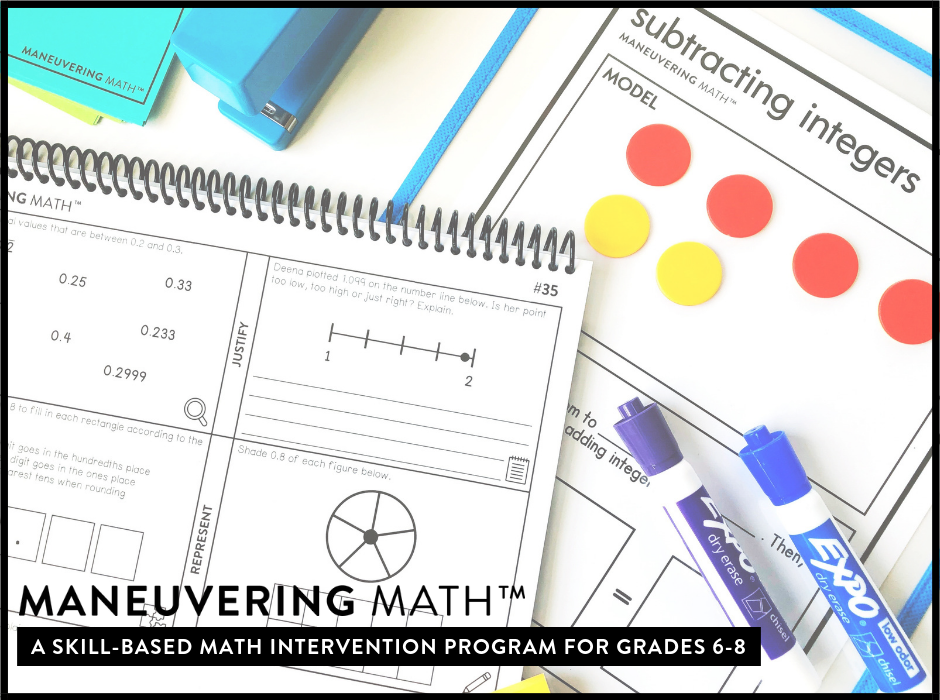
Click to find out more about Maneuvering Math™.