Probability is a great way to end the school year! There are ample opportunities for hands-on practice, experiments, and the computation is fairly simple. Let’s talk about tips for making the most out of this 7th grade skill.
Note: I found so many great probability activities as I was researching that I am going to put together another blog post dedicated to just that, so be sure to check back.
Vertical Alignment
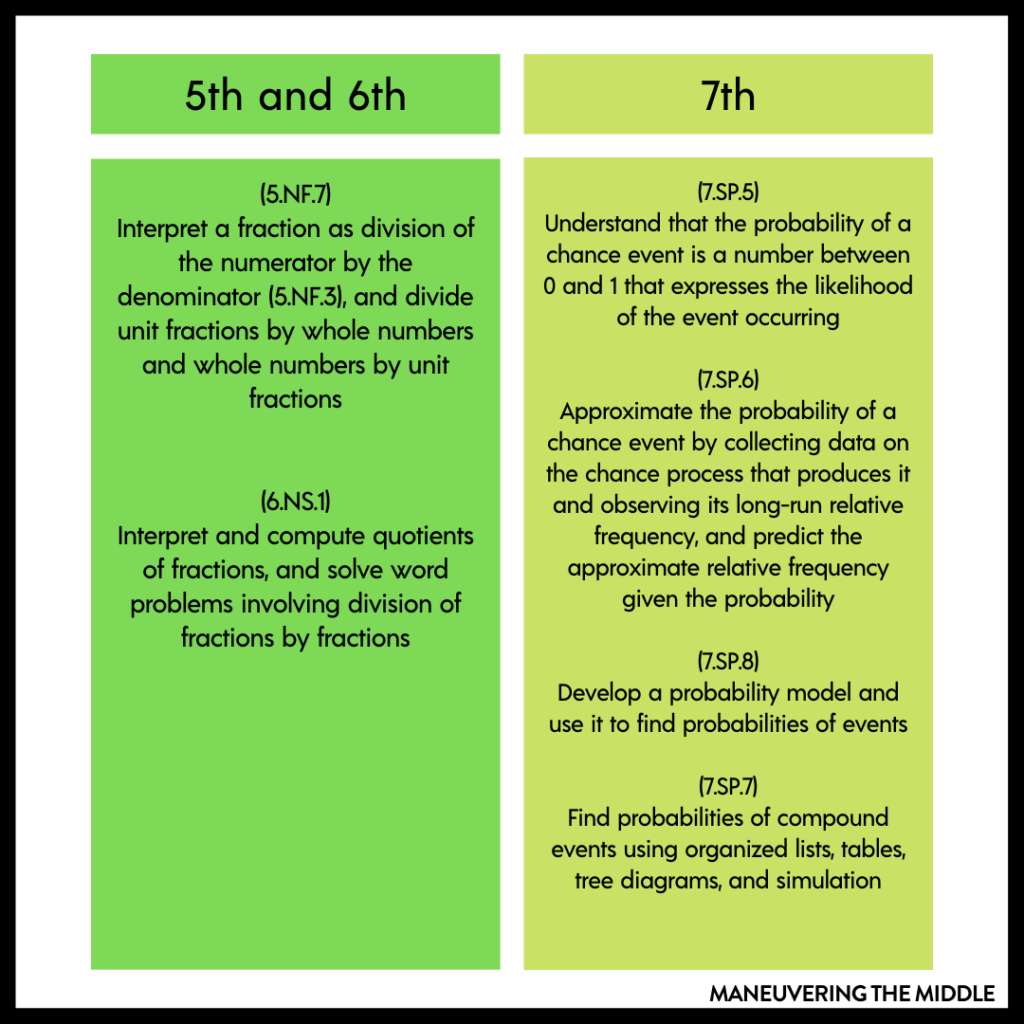
Probability is an isolated skill. In CCSS, 6th grade and 8th grade do not have any probability concepts. However, multiplying fractions will be a key skill needed that does come from 5th and 6th grade and is covered again in 7th grade (7.NS.2). Be sure to review multiplying and simplifying fractions as well as vocabulary like numerator and denominator.
Teaching probability will reinforce so many important skills – solving proportions, converting fractions to decimals (for relative frequency), etc! This is a great unit to cover before reviewing for state tests to review these key concepts.
Hook/Real-World
As I was putting this information together, I realized that pretty much every hook is an experiment or something that you should actually do with your students. Therefore, I will offer you this clip from the movie “21” where the Monty Hall problem is explained. This can cause some spirited debate once students have learned the basics of probability.
Make It Hands-On
Practically every probability problem can be acted out! For introducing and explaining independent and dependent events, provide a baggie and colored tiles for each group.
For independent events, have students physically take one colored tile out of the bag and then replace it, so they could see the denominator stayed the same since the total number of tiles remained the same once replaced.
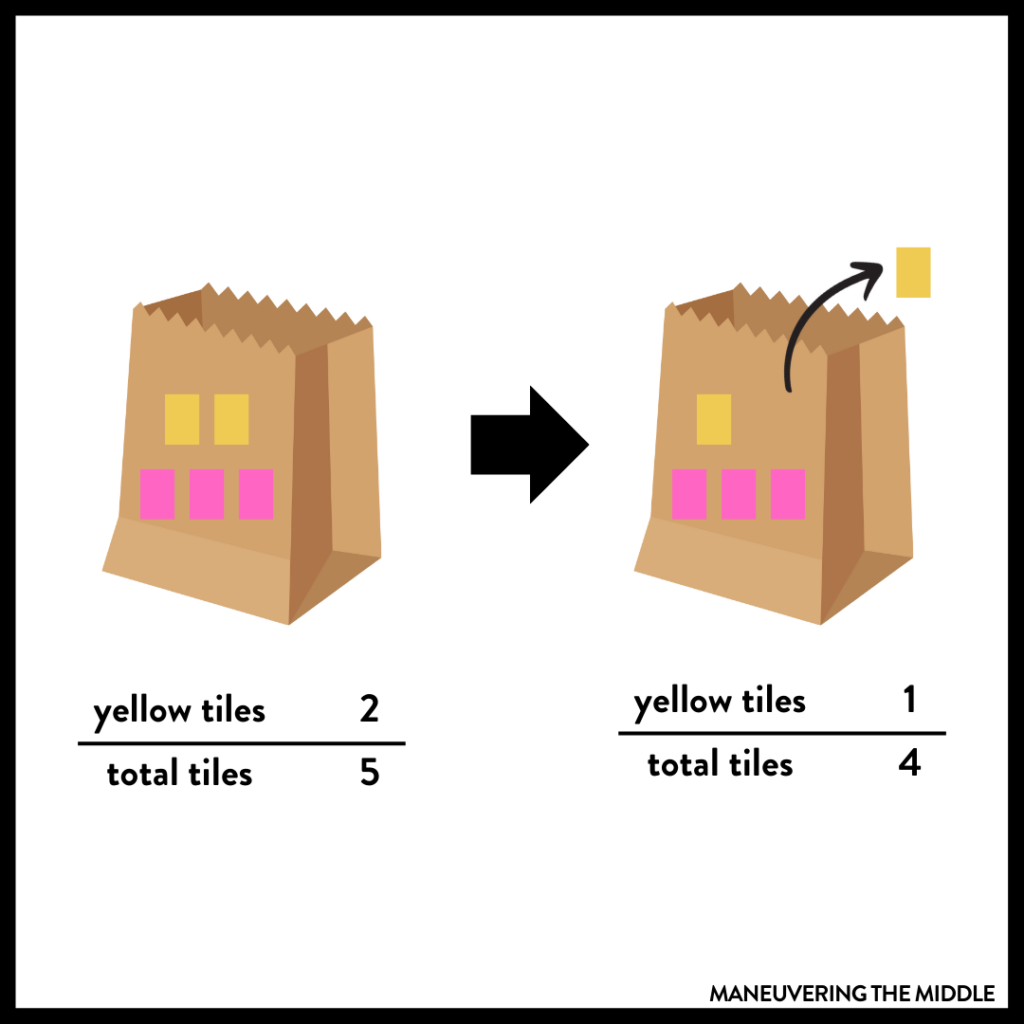
For dependent events, have students physically take one colored tile out of the bag and place it on their desk, so they could see that now the denominator, or the total number of tiles in the bag had changed. This helps them to see that they need to subtract one from the total. This also helps them see that they would need to subtract one from the numerator if there was more than one of that color. For example: what is the probability of drawing 2 yellow tiles without replacement in a bag with 2 yellow tiles and 3 pink tiles? P(y, y) = (2/5) (1/4) Assuming they got a yellow the first time, there is only 1 yellow left and 4 total tiles left.
Number Cubes/Dice
Your students may be tempted to make a silly mistake when solving simple probability with number cubes. Misconception: Let’s say that the problem was calculating the probability of rolling a 4; students would want to write 4/6 because they saw the 4.
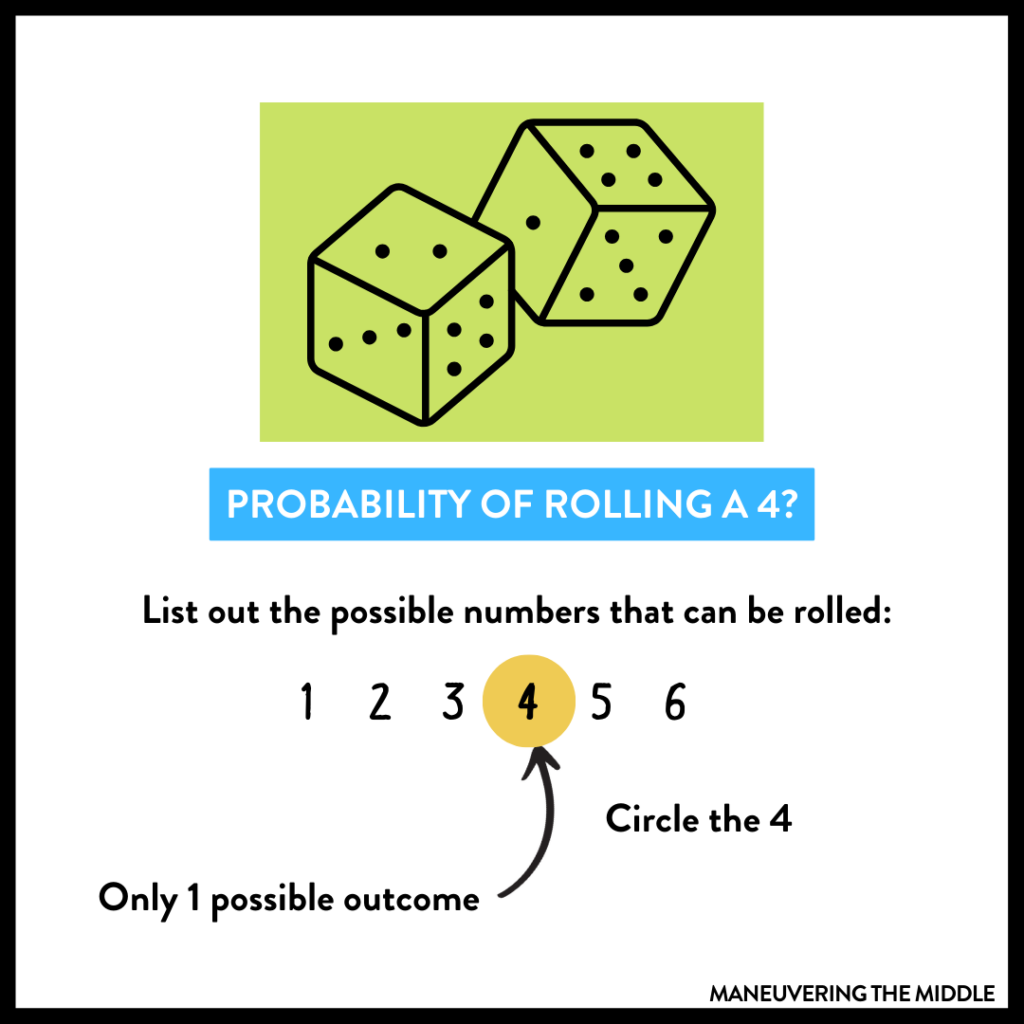
Solution: Have students write out the numbers included on a number cube: 1 2 3 4 5 6 and circle the 4. Then they could see there was 1 possible outcome out of 6 total.
This is a great way for students to show their work. Probability of rolling an odd? Students write out 1 2 3 4 5 6 and circle all of the odd numbers to see that there are 3/6. You can also have students do this with the complement. Probability of not rolling a 3 (P’(3))? List out 1 2 3 4 5 6. Cross out the 3 since they want the probability of NOT getting a 3, and then circle the remaining numbers.
Theoretical vs. Experimental
Theoretical probability answers the question, “What should happen?” while experimental probability answers the question, “What actually happened?” Maneuvering the Middle has a fantastic Theoretical and Experimental Station Activity that will allow students to draw conclusions from multiple experiments. You can find this activity in our Probability Activity Bundle.
Other Tips + Useful Tools
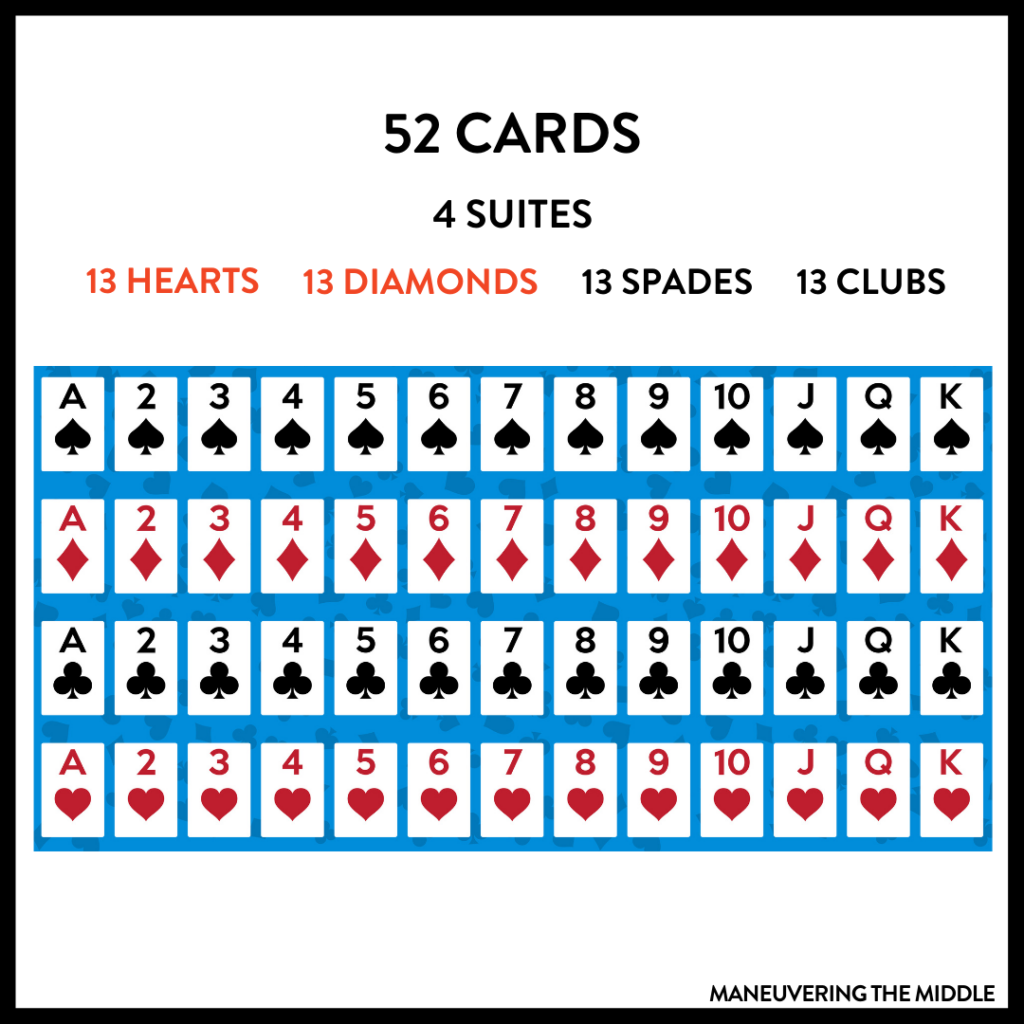
- Usually I recommend anchor charts with math concepts or vocabulary, but for probability I recommend anchor charts on what is included in a deck of cards (suites, face cards, colors) and how many sides a dice has.
- This online probability generator includes editable spinners, bags of marbles, deck of cards, a random number generator, and a dice. You can use this to demonstrate concepts or for students to practice theoretical vs. experimental probability.
- This online Wheel of Names Spinner can be altered to include any word.
Are you ready to teach probability? What tips do you have for teaching probability?