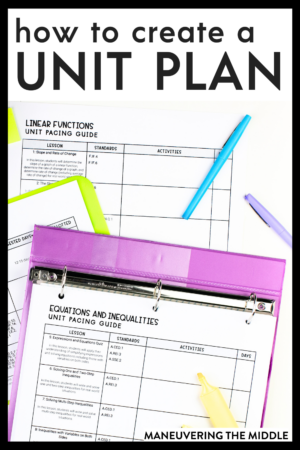
Creating any part of a curriculum from scratch is a challenge! Unit plans are no different. Changing standards, multiple preps, and a too-short planning period are not a recipe for success. However, creating a unit plan will save you time in the long run. Let’s create a unit plan that helps students learn the course material while also saving your sanity.
What exactly is a unit plan?
A scope and sequence will provide a big picture look at the entirety of the year and the progression in which standards will be taught (grab ours here); the unit plan is the zooming in and grouping of lessons that have topics, skills, and themes in common. A unit plan can consists of:
- Standards
- Mathematical practices or process standards
- Teaching strategies and models to be incorporated
- Assessments
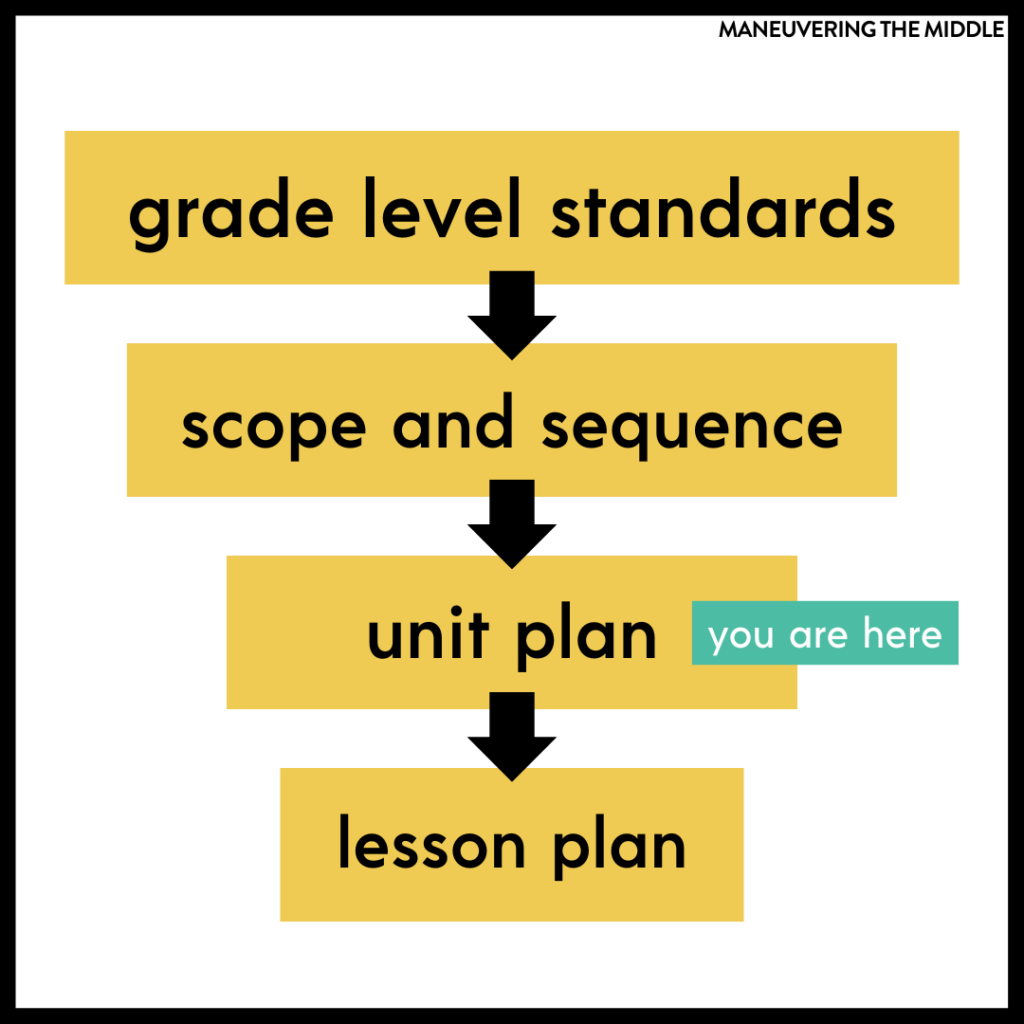
But bonus points if it also includes:
- Vocabulary
- Big Ideas
- Common Misconceptions
- Essential Questions
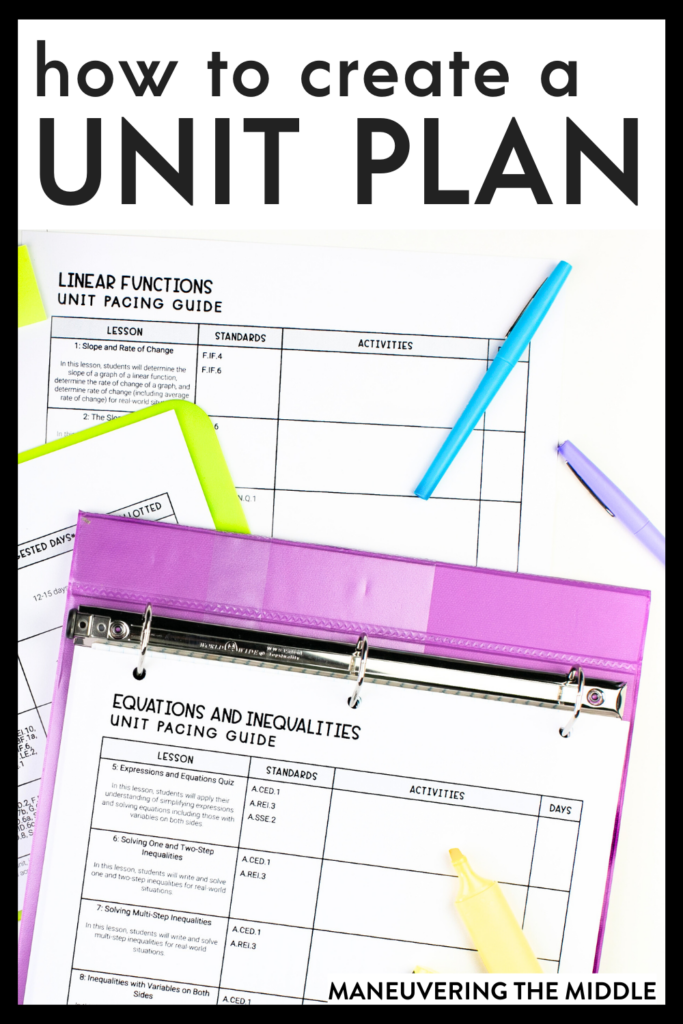
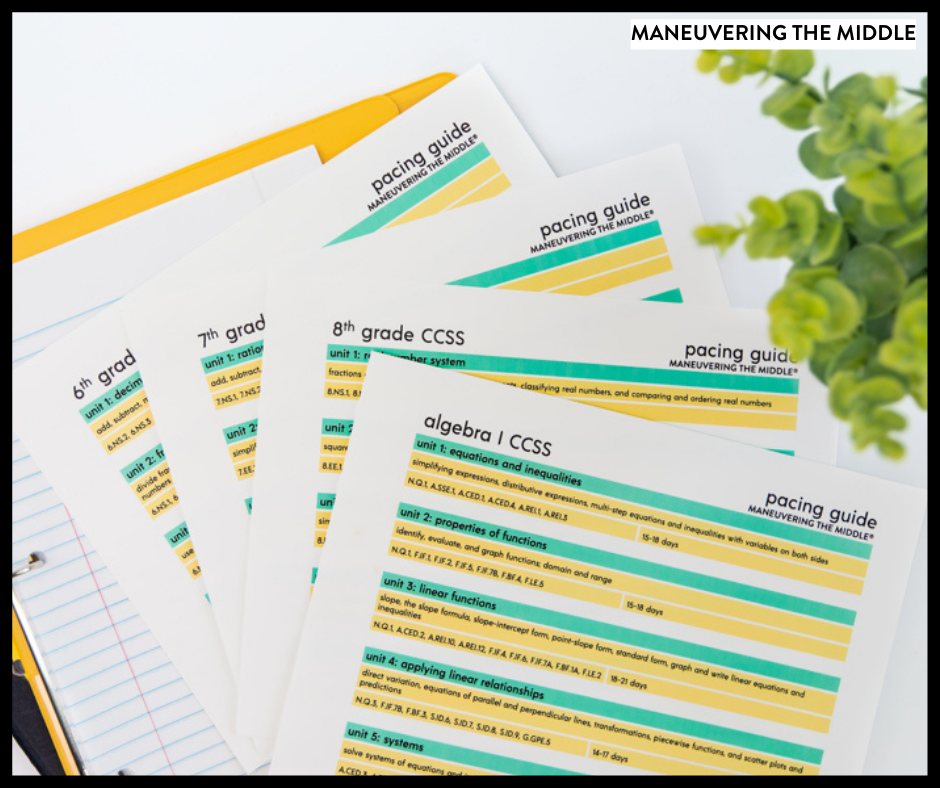
- Pacing calendar
What are the benefits of having a unit plan?
Creating a unit plan will help you front load the work. On the Food Network, Ina Garten has all the ingredients chopped, measured, and ready to be cooked. When I cook, something gets burned. What is the difference here? Prep work! A unit plan is like cutting the veggies, measuring the portions, and preheating the oven. It makes for the actual lesson planning to be faster and more efficient.
Benefits of a unit planning include:
- Content gets adequate time upfront
- Gives direction for planning time
- Prevents standards from being left off or forgotten
- Plan for spiraling in content
- Clear direction for assessments
- Provides a varied approach to activities and teaching strategies
How to Create a Unit Plan
Sometimes school districts will provide a detailed unit plan, but other times they provide something more vague, like the title of a unit and the number of days you have to teach the content within the unit. I have found unit plans to be incredibly effective in maximizing my planning and scaffolding the learning for my students.
1. Break Down the Standards
Start by reading the standards and breaking down the various skills and concepts. Some districts require these to be written as “I Can” statements and used as daily objectives. Even if you are not required to have them, it’s a great idea to post them and share the daily objective with your students throughout the lesson. The idea here is to describe what a student can do by the end of a lesson.
Remember that one standard does not equal one daily objective. For example, let’s take the 7.G.5 standard that says “Use facts about supplementary, complementary, vertical, and adjacent angles in a multi-step problem to write and solve simple equations for an unknown angle in a figure.” In our curriculum, four daily objectives are taught to cover this single standard. Here is one of those daily objectives: “In this lesson, students will identify different types of angles and use complementary and supplemental angles to write and solve equations.”
If you are reading a standard and thinking “what does that mean?” then I will bring you to our next step…
2. Plan Backwards using Your Summative Assessment
If your district provides a scope and sequence, it is possible that they also provide a summative assessment (or a benchmark). If you don’t have a summative assessment provided, I would search for or write questions that are similar in rigor to what students would find on your states’ end of year assessment. Typically you can find the standards coded on the previously assessed state exams.
If you have All Access, the formative and summative assessments are provided, so simply read through and complete the assessment(s) to get a feel for the level of rigor in which the standards need to be taught.
3. Scaffold the skills from basic to complex
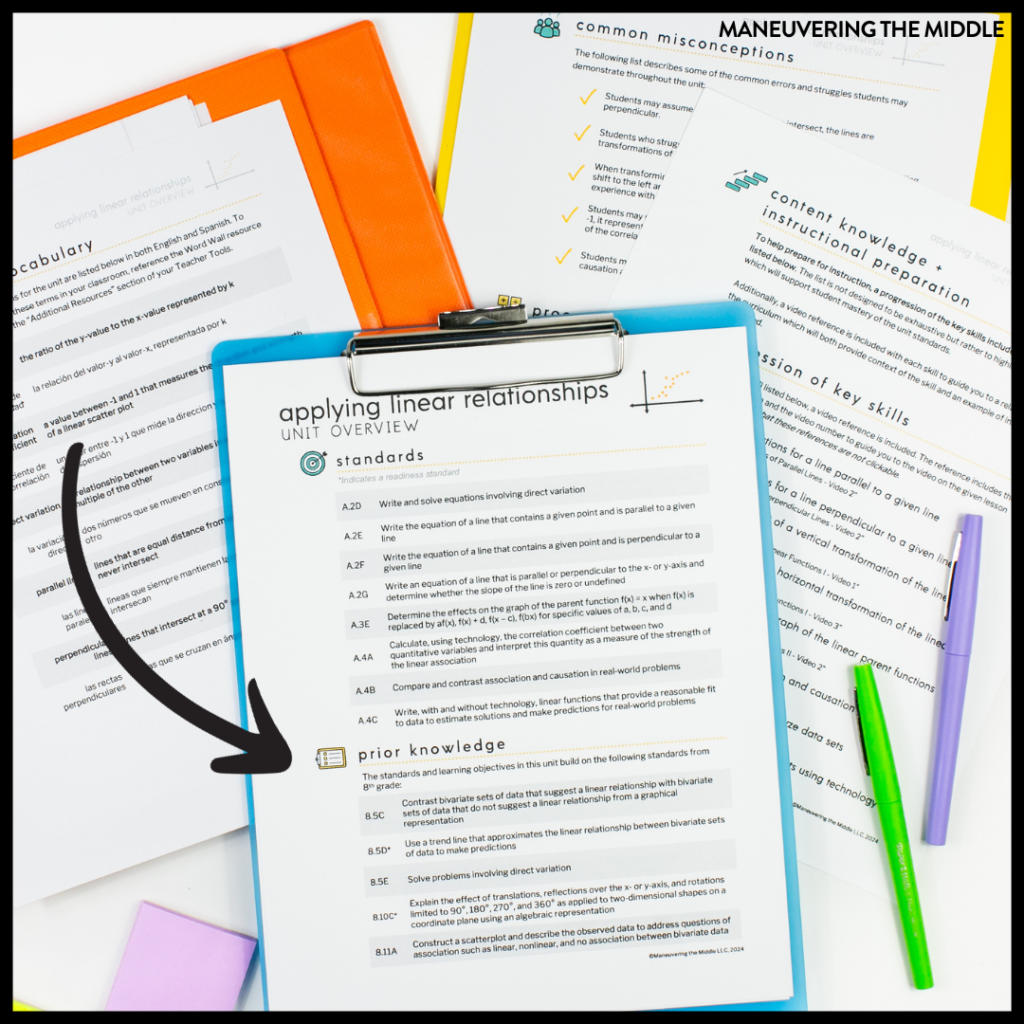
At this point, I grab a calendar and a pencil and begin putting skills on paper. Consider what skills have been learned in prior years and where gaps may exist, so that you can place emphasis and additional time on those areas. Make note of lessons that may be more difficult so that you allow adequate opportunities for students to become familiar with the content. Our All Access Unit Overviews include a section with the prior year’s aligned standards.
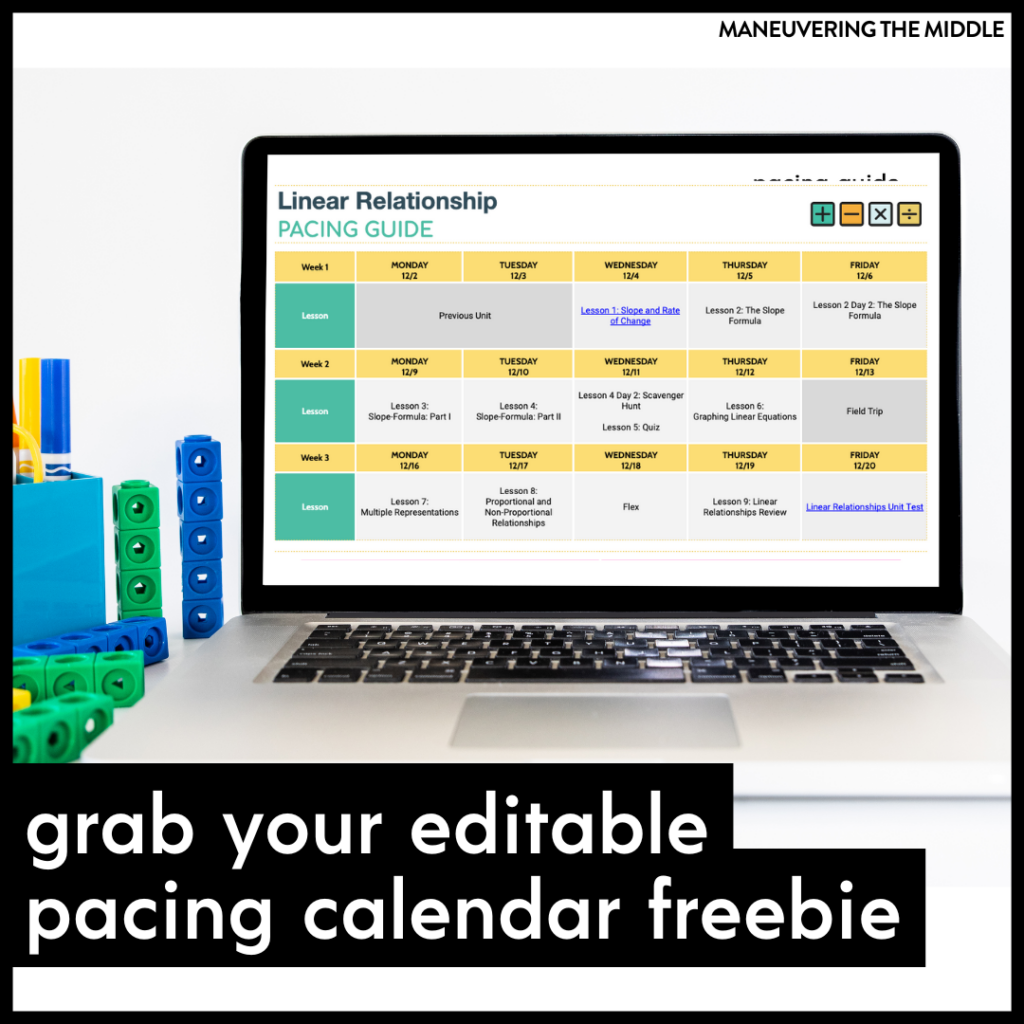
If you want an editable calendar to start brainstorming, download our free unit pacing sheet!
4. Incorporate Mathematical Practices
At this point, I really like to look at the different objectives and skills and brainstorm how I can incorporate the mathematical practices (in Texas we call them process standards) through activities. This might mean stations where students are analyzing for the error or a lab on constructing triangles.
5. Investigate New Strategies
Regardless of how many years you have been teaching, spend some time investigating strategies for instructing the specific math skills in your unit. It wasn’t until I taught 6th grade for the third time that I started teaching multiplying fractions and dividing fractions with models. It is never too late to improve your teaching! Not only will this benefit your students’ content knowledge, but it may lead you to increase (or decrease) the number of days allotted for each skill.
In our All Access Unit Overviews, there is a section that provides a video reference to the key skills included in the unit. Watch the videos to see if there are additional ways to teach the material.
Writing a unit plan can be done, but if you are an All Access member, Unit Overviews have been written for you! You can spend your time internalizing the content on the overview to prepare for your upcoming unit instead of starting from scratch.
Remember that unit plans are plans. They are not written in stone and can be adjusted in real time. How do you write a unit plan?
Maneuvering the Middle has been publishing blog posts for 10 years. This post was originally published in 2015 and has been updated for accuracy and relevancy.
Hi!
Am designing my own unit plans for algebra1 , 2 and precalculus ..
Was wondering if u had any valuable input for anynof those..
Thanx
Wow, you have quite the task Arshia! The best thing I would recommend at that level is taking the vertical alignment between the three into strong consideration and making sure that Algebra 1 gets a strong foundation.
Hi Noelle,
This gives me an AWESOME insight in a very simplistic checklist style of planning units! I am in my final year and about to graduate from Teaching and I really wish I was shown something simple like this from the beginning!
I am open to some tips and advice about general teaching. Have you anything you wish you knew back in college/University??
Kind thanks and Regards
Becc
Oh, I am so glad this post was helpful! Congratulations on such an accomplishment! Keep reading and thinking about your future classroom and students. I think I wish I had been less idealistic in my planning and more concrete with those procedures and routines. Stay consistent and students will respect that and know what you expect. Best of luck!
I love your Unit plan template. Where can I find it?
Hi Melissa! The unit template is a very simple calendar format. I include the pacing guides in my math units and year-long curriculums. At this time I don’t have a template available for other subjects, but I will add that to my to-do list. 🙂 Thanks!
I would also love a copy of the blank unit planning template!! I love this simple idea of unit planing!! It’s going to my year easier!!
Do you have a template for this unit plan you have here? If you do where can I find it? I am a new teacher. I am teaching 8th grade science and have yet to figure out a good way to plan ahead. I am really struggling. I thought about trying this unit plan!
Thanks!
Mica
Hi Mica! I don’t at this time, but I can for sure add that to my to do list. Thanks!
I would love a blank copy of this template! Please let me know if you make it available 🙂 I teach 6th grade ELA.
Hi Brittany! I keep getting this question, and hope to get to it eventually. Its a super busy time of year, but I will do my best!
Same! I’d love to see it in your TPT store!
Me too, please!
Me too!
I was just looking for the 6th grade Endless Bundle but its CCSS! Do you have one for TEKS? I’m in Texas and my district doesn’t like us to use CCSS material.
Hi Beth! Thanks for the question. At this time it is aligned to CCSS, but has a huge overlap with TEKS. The main difference are the personal financial literacy standards. If you have more questions, please feel free to email me or contact me on the site and I can provide more specifics. Thanks!
WOW! This is very helpful. I wish I read this while reach ELA for 6th, 7th, and 8th. This will help me streamline my lessons for my upcoming year.
Thanks so much, Danielle!
Do you have a template you use for unit planning? I am need of one!!!
Not at this time, but its a great idea!
Do you share your Unit Plan with your students?
Since my unit plan can change based on the needs of my students or a variety of other reasons, I don’t share my unit plan with my student. I do share when we have quizzes and when the summative assessment is.
do you have this calendar available for purchase?
Hi, Melissa – I don’t, but I used Powerpoint and tables. Very doable!
A thousand thank yous!!! You are a God-send! I am in my second from the final class to receive my master’s degree in special education and become licensed to teach. This will be such a help.