Welcome, New Math Teacher! If you have made it to this blog post, you are most likely about to enter your first year of teaching or your first year of teaching math. (And if you are a veteran math teacher, we would love for you to share your tips in the comments :))
Let me be the first to offer my congratulations! I hope that you will find our blog useful, so please stay a while.
We will be covering everything that will set you up for success in your first year. Be sure to check back to read:
- Part 2 – Cultivating a Strong Classroom Culture
- Part 3 – What To Do When Everything is Urgent and Important
- Part 4 – Our Favorite Practices
Today’s post will be all about what to spend your time and energy on this summer. You have a huge task ahead of you and still a month before you begin. How should you use this time before you? Let’s dive in!
What To Focus on This Summer
Most advice (including my own) around being a first year teacher is about building relationships with students and creating consistent routines and procedures for your classroom. But if you are reading this in July, you don’t have a classroom of students to start working on this yet. So what to do while you are anxiously waiting for the start of the year?
Get to Know Your Content
This was a hard reality I discovered when I started teaching math: being a good math student does not always make a good math teacher. Math was always my best subject, so when it was time to reach struggling students, I felt stuck. I had learned math this one specific way and it worked for me, so I lacked additional tools that could help me help my students.
You don’t know what you don’t know, but you can assume that the way you may have learned a math skill is not the only way that you can teach it. So it is time to educate yourself!
Before I get into specific math skills, I want to recommend reading about and implementing the Concrete, Representational, Abstract framework in your daily lesson plans. This study is short and does a great job of summarizing the CRA framework. We also have two posts: here and here.
The CRA framework helps guide students from the hands-on materials (Concrete), to the drawings and models (Representational), and finally, to the equations and algorithms (Abstract). By using the CRA framework, you are setting students up to understand the WHY behind the procedures of various skills which develops their conceptual understanding, builds math confidence, and gives students multiple methods for solving a problem. (Hint: you don’t need a huge supply of math manipulatives to use the CRA framework – check out our favorite math manipulatives here and how to get them on a budget.)
Let’s talk about what you are teaching! If you know what grade you are teaching, then I would start by looking at the standards for that grade level. You can find Common Core standards by Googling “CCSS + math + grade level” and by clicking here for the TEKS (if you are in Texas). If your state does not teach Common Core, I would search your state + grade level + math standards.
Don’t expect to read your grade level’s math standards and instantly understand what you are reading and supposed to teach. But do read through the standards and make some observations. Here are some guiding questions:
- Are any topics or skills mentioned more often than others?
- Are there any words or phrases that I am unfamiliar with?
- Are there any skills that I only know one method of solving?
For the last question specifically, if you noticed a few or many skills that you only know one way of solving, use the internet to learn more. Before teaching 6th grade math, I knew exactly one way to solve a proportion: cross multiply and divide. I now know about 16 ways to solve a proportion: finding the scale factor, bar models, double number lines, scaling, graphing, and so forth. This is something that you can expect to do throughout the school year. A good rule of thumb is to come ready to teach with at least two different ways a student can solve.
Now I am going to make a few plugs 😉
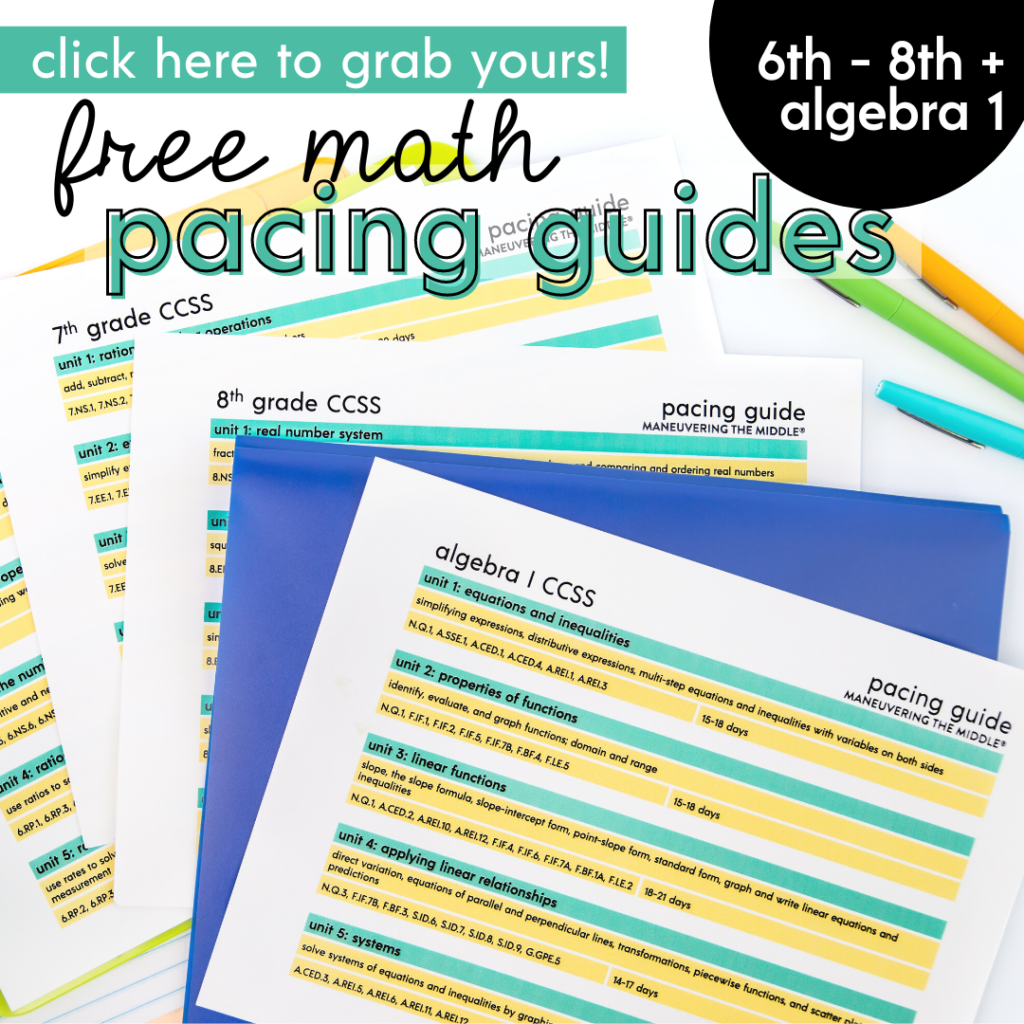
You can grab our middle school math + algebra 1 pacing guides by clicking below. This will help you get an idea of how our Maneuvering the Middle curriculum is organized.
Math teachers are incredibly helpful and we have almost 10k in our Maneuvering the Middle VIP Facebook Group. Join us, read and learn, and post your own questions.
Join All Access! I truly believe if I had access to this curriculum in my first year of teaching math, I would have been less stressed and 100% more confident to tackle these standards. You can learn more about All Access here (like how it has everything you need and more to teach math), but we hear from teachers and administrators all the time about how our student video library helps new teachers learn and internalize the content.
What to Spend Your Money On
If you can help it, try to resist the temptation to start spending money on your classroom until you have done some research.
First, find out if you have a budget from the school. I have been given $50 to unlimited funds (within reason) to spend on my classroom. Unfortunately, (and might I add, wrongly) some teachers receive zero dollars for their classroom. If you see something that you MUST have, at least hang onto the receipt since it may be reimbursable.
Next, find out what the school already provides (or doesn’t provide). Your school may keep the teacher workroom stocked with #2 pencils, so you may never need to make that purchase. You may find out that you have a budget of $200 for the year, but the school doesn’t provide copy paper, so you may want to use that $200 on a paper supply.
You may want to purchase classroom posters and decorations! I get it, but it can get expensive, so be sure to check out how I decorated my classroom on a serious budget. All you need is colored cardstock and a printer.
Whether your school is paying or you are paying out of pocket for your classroom, I would recommend checking out our list of essential classroom supplies. This list even includes how necessary I think the item is.
Lastly, remember that asking for donations from parents at Open House is totally acceptable.
If you are a new math teacher, let us know how you are spending your summer. Veteran teachers, any additional advice you would include for the summer before school starts? Be sure to come back next Tuesday for more new math teacher tips.
This has been amazing at easing my worried mind about my first year teaching middle school math. Thank you a million times over.
Just because they’re middle school aged students doesn’t mean that they know how to behave in your class. Don’t assume that they understand what you want, teach those procedures explicitly until they become 2nd nature. And, the students will only get away with what you let them get away with.